University of North Texas

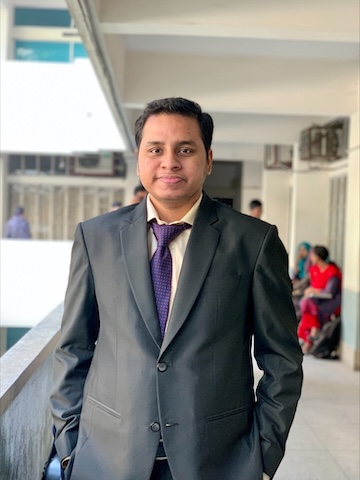
Iftekhar Hossain
I grew up in a two-bedroom apartment in Dhaka. My father was the only earner in our family, but he did something that shaped everything that came after: he kept bringing home books. Fiction, nonfiction, whatever he could find as he wanted us to read. We didn't have cable in our TV. There was no internet. For most of my childhood, a radio was our only real window to the world beyond our neighborhood.
But we had newspapers. I developed a habit early of reading them, really reading them, before I was even a teenager. I wasn't looking for the headlines. I was looking for the stories about people. And one type of story kept catching my attention: Bangladeshis going west to study, earning scholarships, going to universities in America and Europe. I remember thinking: that could be me. That should be me.
From Class 3 through Class 10, I never finished second. First place, every year. When I took my SSC exams; what you'd call the high school completion exams in the US, I placed in the top 20 nationally. Same with HSC, the final secondary qualification. I wasn't the only smart student in Bangladesh. But I was disciplined, and I was driven by something that newspaper reading had planted: the belief that if I performed, doors would open.
Then came university. I was admitted to the Faculty of Business Studies at the University of Dhaka, the country's top business school. Within that, I got into the Department of Finance, the most competitive department in the country. The admission test was brutal. I scored in the top 50 nationally to get there. That's where I met my wife. She was in my cohort; brilliant, driven, maybe even more naturally talented than I was. We studied together, pushed each other, shared the same dream of studying in the West. At one point of life, I knew she wasn't just my classmate. She was my partner for life. We got married later on.
In my university life, for the first time, I was around world-class education. Professors who had studied abroad, curricula that matched international standards, peers who were equally serious. It wasn't just about getting good grades anymore, it was about understanding that the world of finance operated at a level I was only beginning to glimpse. My dream of studying in the West didn't weaken. It grew stronger. I could taste it.
I finished my BBA in Finance and went directly into the MBA program at the same institution. In one semester in BBA, I earned a perfect 4.0 GPA; every class, top marks; and received the Dean's Merit Award for it. When I graduated from my MBA, I finished in the top 1% of my cohort. By any measure, I had done what I set out to do. I had the credentials. I had the knowledge. I had the dream within reach.
But then, while I was still completing my MBA, I saw something else: an opportunity to serve my nation using the finance knowledge I'd built. I wasn't going to run from that. I applied to the Bangladesh Air Force Finance Branch. I got the job offer before my MBA results even came in. What followed was four years that changed me in ways I didn't anticipate.The military training was brutal. I went in as an introverted, frightened young man. I came out transformed as polished, extroverted, someone who could stand in front of a room and command it. But my service wasn't confined to finance. My scope of work went far beyond what my branch designation suggested. I took on operational tasks that pushed me into the center of critical moments in my country's history.
I served duty during the devastating floods that swept through Bangladesh, working in waterlogged areas, coordinating logistics when everything was chaos. I was stationed during the July Uprising movement of 2024; one of the most consequential political moments in Bangladesh in decades and I was there for the critical scenes of that history, doing operational work that mattered. I worked through national elections. Everywhere the nation needed to mobilize, I was part of that mobilization.
I stood first in every military course I took and every finance-related course; the same pattern from my school days, but now with different stakes. The Air Force recognized my service with a letter of appreciation for outstanding contribution to BAF during my time there. And because of that performance, I was posted at the main Air Force base for almost my entire service life, a rare placement that reflected how seriously they valued my work.
When my service ended in June 2026, I had transformed. I wasn't just someone with credentials anymore. I was someone who had been tested, who had worked under pressure, who understood how organizations actually function when the stakes are real. I faced a choice. I could have built a comfortable career in banking or industry in Bangladesh, leveraging the military network and the finance degree. Instead, I applied to PhD programs.
My wife had already taken the leap a year earlier. She came to UT Arlington to pursue her own PhD in Finance; a brilliant scholar in her own right, now teaching as a lecturer back in Bangladesh while building her doctoral research. When I applied, I aimed for the best programs I could find. I scored more than 330 on the GRE; one of the highest scores the Ryan College of Business has ever received from a student. More importantly, I knew where I wanted to be.
I'm now a fully funded PhD student in Finance at the G. Brint Ryan College of Business at the University of North Texas, just thirty minutes from my wife's program at UT Arlington. Both of us doing PhDs in finance at universities near each other, that's rare. That's a gift.
The moment I arrived at UNT, I understood why I chose this place. The G. Brint Ryan School of Business is exceptional. The building itself is state-of-the-art; everything from the design to the technology reflects an institution that invests in its students.
But the real asset is the people. The professors are extraordinary: world-class scholars who are also genuinely invested in mentoring. My classmates come from everywhere; I'm the sole cohort member in Finance this fall, which means I get individual attention and mentorship that would be impossible in a larger cohort. The diversity in the classroom, in research approaches, in perspectives; it mirrors the global nature of finance itself.
And the research ecosystem here is real. Data is available. Opportunities are genuine. The faculty are actively engaged in their own research and they're bringing us into it. This isn't a program where you come to sit in classes. It's a place where you come to do real work. When I look back at that kid reading newspapers in Dhaka, dreaming of studying in the West, I realize something: this dream wasn't just about leaving Bangladesh. It was about joining a community of scholars committed to rigorous thinking, global perspective, and actual impact. That dream is now my daily reality.
Here's what I want to say to anyone reading this; whether you're a UNT student, a prospective student, or someone back home watching this story unfold: I'm not special. I'm not uniquely gifted. What I am is persistent, disciplined, and willing to take unconventional paths. I read newspapers when there was no internet. I stood first because I showed up and did the work. I joined the military because I saw an opportunity to serve. I came to the United States because I refused to let geography limit my ambitions.
My country people are inspired by what I'm doing now. Young people in Bangladesh who are reading this story, many of them are starting to dream the dream I started dreaming at seventeen years old. They're seeing that it's possible. They're understanding that excellence, wherever you come from, can open doors.
And to UNT students reading this: You're in an exceptional place. The professors who mentor you, the building you study in, the resources available to you, the diversity of your cohort; these are not things to take for granted. They're things to leverage. The world is watching programs like ours because they produce research and thinkers who matter. You have an opportunity here to be part of something significant.
Every part of my journey; the newspaper habit, the first-place finishes, the Dean's Award, the military transformation, the operational service during critical moments, the partnership with my wife, the 331 GRE score, and now this extraordinary community at UNT; is part of why I'm here.
And I'm only getting started.