University of North Texas

F = Full-time Enrollment
A = Authorized for Work
C = Changes to Enrollment
T = Timing of Documents
S = Stay in Touch!
The Department of Homeland Security considers you to be in valid F-1 status if you fulfill all of the conditions of your F-1 visa.
- Attend the school whose I-20 you used to enter the U.S.
-
- Students must be approved for concurrent enrollment by UNT to attend another F-1 approved school.
-
- Maintain good academic standing.
-
- Remember, delays caused by academic probation or suspension or a student's repeated inability or unwillingness to complete his or her course of study are not acceptable reasons for an Extension of Stay.
-
- Enroll each semester as a full-time student.
-
- Graduate Students = 9 credit hours or more
- Undergraduate Students = 12 credit hours or more
-
- Don’t enroll in too many online courses
-
- Graduate students must have 6 credit hours or more of on-campus classes.
- Undergraduate students must have 9 credit hours or more of on-campus classes.
-
- Don’t change majors, degree levels, or transfer without approval from ISSS.
-
- After September 15, 2026, Graduate students are not permitted to change majors or transfer to another F-1 approved school.
-
- Complete the undergraduate F-1 transfer procedure to change schools within the U.S.
when you change schools.
-
- After September 15, 2026, undergraduate students may only transfer to another school after they have completed one academic year in the U.S.
-
- Don’t work more than 20 hours per week on-campus while classes are in session.
- Only work off-campus with specific written authorization from International Student
and Scholar Services or USCIS (US Citizenship and Immigration Services).
-
- CPT requires approval from ISSS
- OPT requires approval from USCIS
-
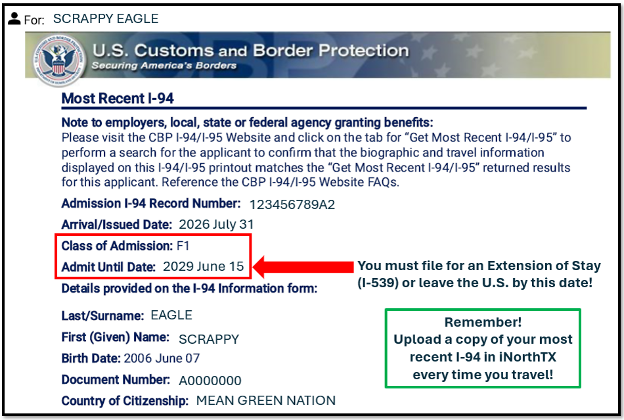
- Extend your stay in the U.S. before your I-94 AUD (Admit Until Date) or exit the U.S.
-
- An I-20 extension, change of level I-20, or OPT authorized I-20 may be required before you file for an Extension of Stay in the U.S. with USCIS.
-
- Extend your stay in your degree program before the program completion date on your
I-20.
-
- An I-20 extension may be required before you file for an Extension of Stay in the U.S. with USCIS.
-
- Complete the change of level procedure when changing from one educational degree level
to another (within 15 days of changing educational degree level.)
-
- Change of level to a lower or the same degree level are only permitted if the first degree at that level was completed before September 15, 2026.
-
- Maintain sufficient financial resources to support yourself for the duration of your
program without U.S. government assistance.
-
- Update ISSS if you have updated financial documents.
- New financial documents are required for an I-20 extension or change of level I-20.
-
You are out of status if you do not fulfill the conditions of your F-1 visa.
If you are out of status, you lose privileges and benefits:
- Eligibility for employment on and off campus
- Automatic visa revalidation for trips to Canada, Mexico, and the Caribbean islands except Cuba (not available to citizens of some countries)
- Extension of program through the notification procedure
- Transfer to or from another university in the U.S. through the SEVIS procedure
- Change from one educational level to another through the SEVIS procedure
- Practical training
- Visa stamp may be cancelled
To get back in status:
- Apply to USCIS for reinstatement within the U.S. (requires a filing fee for USCIS), OR
- Leave the U.S. and be readmitted with a new I-20.
Students who have worked since becoming out of status in the U.S. are not eligible for reinstatement in the United States.
If your I-94 has an Admit Until Date (AUD):
- Your F-1 status expires on the AUD shown on your I-94, unless you receive an extension, change status, or depart the U.S. before that date.
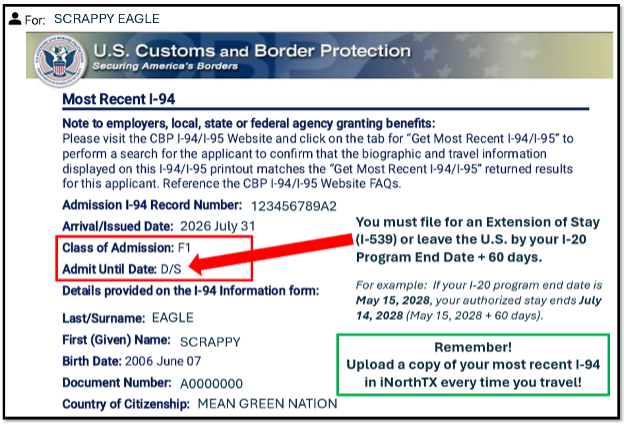
- If your I-94 says D/S (Duration of Status):
- Your F-1 status expires on the earlier of:
-
- Your I-20 program end date, or
- November 14, 2030 (4 years + 60 days after the September 15, 2026 effective date).
-
Examples
| Situation | F-1 Status End Date |
|---|---|
| I-94 shows AUD of June 15, 2028 | June 15, 2028 Includes 30-day grace period. |
| I-94 shows D/S and I-20 ends May 15, 2028 | July 14, 2028 I-20 end date + 60 day grace period* |
| I-94 shows D/S and I-20 ends December 20, 2031 | November 14, 2030 Maximum of 4 years from September 15, 2026 + 60 day grace period* |
*If you currently have D/S on your I-94, and you travel out of the U.S., when you return, you will get a new I-94 AUD and will only have a 30-day grace period.
-
If your I-94 says D/S, you can stay up to 60 days after completion of your program as long as your program end date is before November 2030. You may not work during those 60 days.
- If your I-94 has an AUD (Admit Until Date), you can stay until the AUD date on your I-94. This date usually includes your grace period. You may not work during your grace period.
-
If you do not complete your program and withdraw from UNT with approval from ISSS, you may only stay for 15 days after your Authorized Early Withdrawal is processed. Withdrawing without approval from ISSS will result in you falling out of status.
Remember to check your I-94!